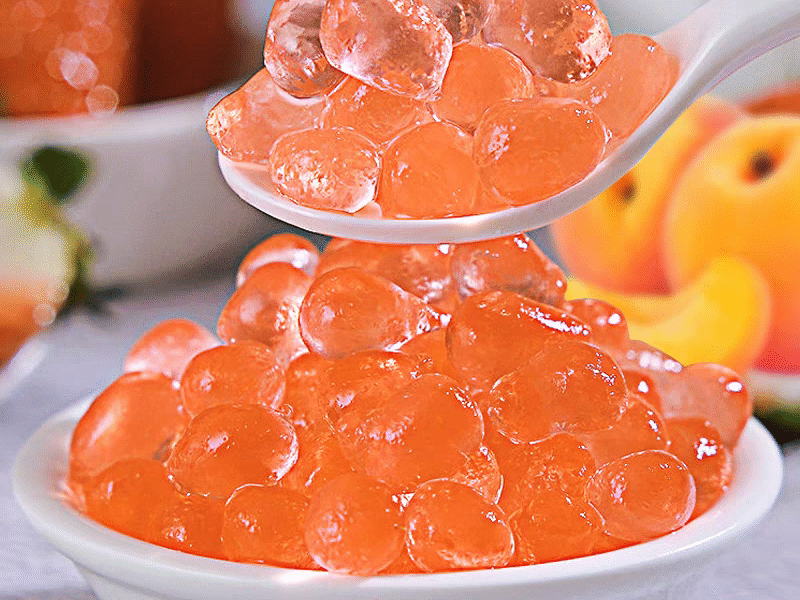
1. Introduction: The Rise of Crystal Boba in the Modern Bubble Tea Industry
In today’s beverage market, texture innovation defines success.
Beyond classic tapioca pearls, Crystal Boba (also known as Agar Boba) has become a must-have ingredient in modern bubble tea formulations — especially for low-calorie, vegan, and transparent drink concepts.
Unlike tapioca pearls made from cassava starch, Crystal Boba uses agar-agar, a natural seaweed-derived hydrocolloid.
The result is a chewy yet translucent gel sphere, stable at room temperature and ideal for cold or fruit-based beverages.
According to Grand View Research’s 2024 Bubble Tea Market Report, the market for alternative toppings such as Crystal Boba is growing at 10.3% CAGR, driven by consumer demand for plant-based and low-sugar textures.
2. Key Ingredients and Their Functional Roles
The quality and texture of Crystal Boba depend entirely on the choice of raw materials and the control of the gelation process.
| Ingredient | Function | Key Consideration |
|---|---|---|
| Agar Powder | Main gelling agent | Choose 700–900 g/cm² gel strength agar for elasticity |
| Konjac Powder (Optional) | Adjusts chewiness & water retention | Adds springiness without stickiness |
| Calcium Lactate / Calcium Chloride | Crosslinking agent | Enhances firmness and transparency |
| Sugar Syrup / Fructose | Sweetening & flavor base | Prevents dehydration in storage |
| Citric Acid (buffer) | pH stabilizer | Maintains gel clarity and flavor balance |
| Natural Colors or Flavors | Optional | Added post-gelation for fruit-flavored variants |
👉 For industrial ingredient sourcing, see our Bubble Tea Raw Materials Page.
3. Process Flow Overview
The industrial Crystal Boba production process can be summarized in 6 main stages:
- Hydration and Mixing of Agar Base
- Heat Dissolution and pH Adjustment
- Droplet Formation (Spherification)
- Cooling and Gelation
- Washing and Soaking in Syrup
- Packaging and Sterilization
Each step requires tight control of temperature, viscosity, and droplet size — which ultimately define chewiness, transparency, and shelf life.
4. Step-by-Step Production Process
Step 1: Hydration and Mixing
- Add 1–2% agar powder (w/w) into hot deionized water (~80 °C) under constant stirring.
- Optionally blend in konjac powder (0.2–0.5%) for elasticity.
- The goal is complete dispersion — no clumps or undissolved particles.
Pro Tip: Pre-mix dry agar with a small amount of sugar before adding to water. This prevents surface gelatinization.
Step 2: Heat Dissolution and pH Adjustment
Once dispersed, heat the mixture to 95–98 °C for full agar activation.
At this stage, you can add:
- Sugar or syrup for taste
- Citric acid (pH 6–6.5) to maintain clarity
- Calcium lactate (0.1–0.3%) if firmer texture is desired
Continuous agitation is essential — uneven heating causes “fish-eye” gels or inconsistent viscosity.
🔗 Learn more about agar thermal behavior from ScienceDirect’s Food Hydrocolloid Studies.
Step 3: Droplet Formation (Spherification)
This is the core technical stage of Crystal Boba manufacturing.
The hot agar solution is dropped into a cold calcium bath (5–10 °C) via:
- Peristaltic pumps with nozzle arrays (industrial scale)
- Vibration drippers for consistent droplet size (5–10 mm diameter)
Upon contact, the outer layer gels instantly while the inner core remains slightly fluid.
Droplet size is influenced by:
- Nozzle diameter
- Flow rate
- Agar concentration
- Dropping height
💡 Insight: Lower calcium ion concentration (0.05–0.1 M) yields smoother texture, while higher levels create firmer, brittle gels.
Step 4: Cooling and Gelation
After initial formation, let the beads rest for 15–30 minutes in the calcium bath to complete gelation.
Then, transfer them to cold deionized water to remove surface calcium and reduce stickiness.
Maintaining uniform cooling prevents deformation — use continuous rotary drum coolers for large-scale lines.
Step 5: Washing and Soaking
- Wash Crystal Boba thoroughly to remove excess ions.
- Soak in light fructose syrup (15–20 °Brix) for at least 2 hours to enhance sweetness and transparency.
- For flavored versions, this syrup can contain fruit extracts or colorants.
See our detailed Syrup Formulation Guide for optimizing sweetness profiles.
Step 6: Packaging and Sterilization
Industrial packaging formats:
- RTS (Ready-to-Serve) Crystal Boba: packed in fructose syrup, sterilized at 90 °C for 15 min.
- Frozen Crystal Boba: vacuum-packed without syrup, stored at –18 °C.
For export markets, retort pouches (120 °C / 15 min) ensure extended shelf life (12–18 months).
👉 Learn how to manage long-term stability in our Non-Dairy Creamer Storage Guide — same packaging principles apply.
5. Equipment Configuration for Crystal Boba Lines
A standard mid-to-large Crystal Boba production line includes:
| Equipment | Function |
|---|---|
| Agar dissolver & mixing tank | Homogeneous heating and dissolution |
| Inline homogenizer | Uniform gel base viscosity |
| Droplet forming unit | Precision nozzle or vibration-based system |
| Calcium setting tank | Controlled gelation environment |
| Cooling drum or water bath | Uniform texture and transparency |
| Washing & syrup soaking tanks | Flavor infusion and purification |
| Automatic filling machine | Syrup-filled pouch or cup |
| Retort sterilizer | Extended shelf life packaging |
Automation through PLC control ensures reproducibility and reduces labor dependency — key for global-standard OEM factories.
More examples available from GlobalData’s Beverage Processing Technology Portal.
6. Quality Control Parameters
| Property | Test Method | Target Value |
|---|---|---|
| Diameter Uniformity | Digital caliper | ±0.5 mm |
| Texture Hardness | Texture analyzer | 200–300 g force |
| Transparency (L-value) | Colorimeter | ≥ 85 |
| Syneresis Rate (Water release) | Weight loss test | < 3% after 7 days |
| pH Stability | pH meter | 5.8–6.5 |
| Microbial Load (TPC) | Plate count | < 100 CFU/g |
Adopt HACCP and ISO 22000 protocols to ensure consistency and export readiness.
Learn about certification procedures on our About Us Page.
7. Process Challenges and Optimization Tips
| Problem | Cause | Engineering Solution |
|---|---|---|
| Irregular shape / tailing | High solution viscosity or low surface tension | Adjust temperature (↓2 °C) or nozzle pressure |
| Opaque beads | Low gel strength or pH drift | Use higher-grade agar (≥800 g/cm²), correct pH |
| Poor chewiness | Excess calcium or overcooling | Reduce calcium bath concentration |
| Syrup leakage after storage | Weak gel matrix | Add konjac or low-acyl gellan for firmness |
| Short shelf life | Microbial growth | Retort sterilization and aseptic filling |
Regular in-line monitoring of viscosity (Brookfield) and pH keeps your process under control.
8. Innovations in Crystal Boba Technology
The next generation of Crystal Boba focuses on functionality and sensory diversity:
- 🌱 Vegan-certified, allergen-free gel systems using carrageenan blends.
- 🍓 Color-stable fruit-flavored Crystal Boba through encapsulated natural pigments.
- 🧊 Cold-soluble formulations for ready-to-drink (RTD) beverages.
- ♻️ Low-energy drying and water-recycling systems for sustainable production.
A Mintel report on texture innovation notes that 62% of Gen Z consumers value “fun and translucent textures” in beverages — positioning Crystal Boba as the future of global bubble tea formats.
9. Conclusion: Precision Manufacturing for the Future of Bubble Tea
Crystal Boba represents the intersection of food science, sensory design, and process control.
Factories that master droplet formation, agar gelation, and syrup preservation gain a strong competitive edge in the rapidly evolving milk tea market.
Whether you’re developing private label Crystal Boba or upgrading an existing production line, technical consistency is your key differentiator.
👉 Learn more about our OEM Bubble Tea Solutions or contact our engineering team for process consultation via the Contact Page.